
What late-onset Alzheimer’s taught our family,and why every caregiver needs a Plan B
I woke at two in the morning to a strange kind of quiet. It was the kind where a house settles under weight it doesn’t usually carry. I heard footsteps, steady rather than hesitant. Then a shadow crossed the doorway of my room and stopped. For a few seconds I did the math a person does in the dark: intruder, exit, phone. Then the shadow smiled.
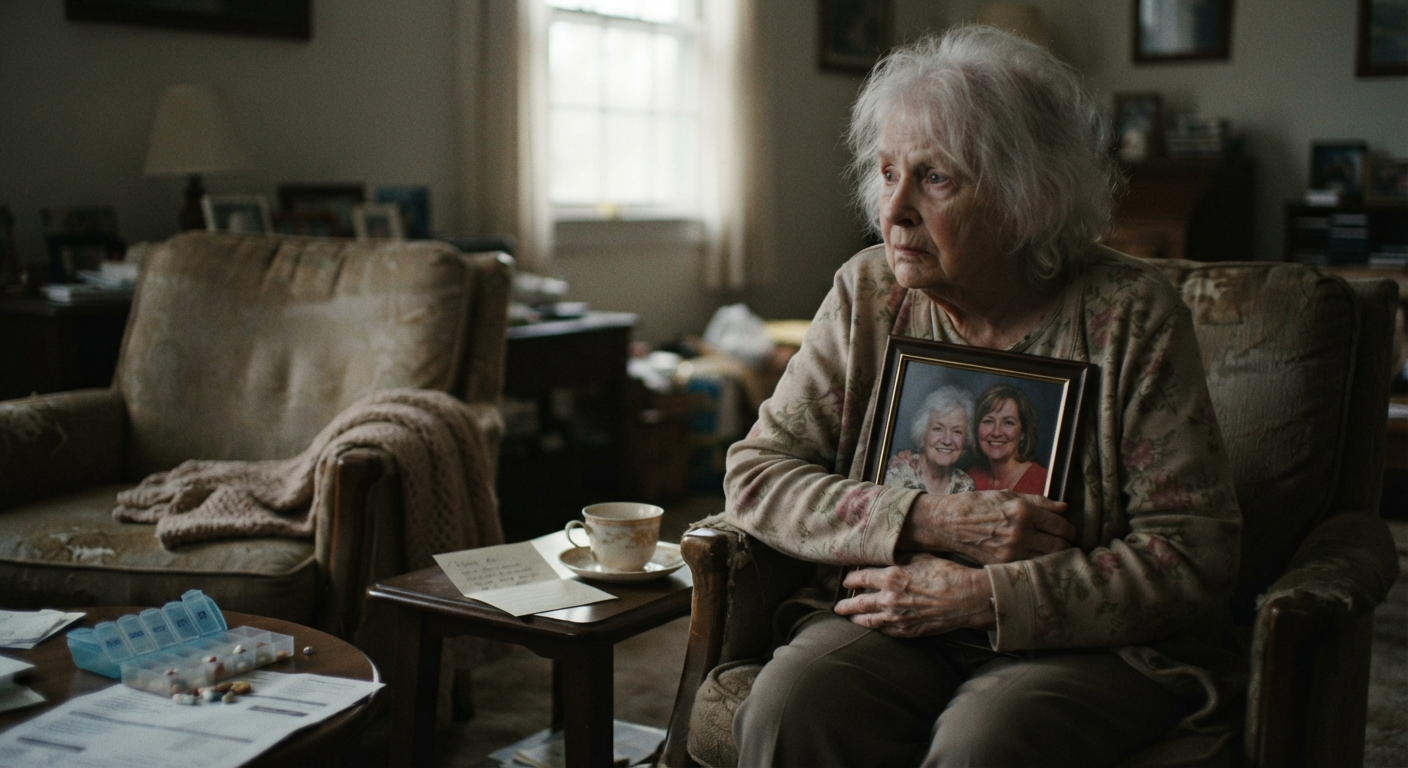
It was my great-aunt, fully dressed and wide awake. She was ready, by every visible sign, to start her day three hours before sunrise. She had her walker in hand and her hair done. Her clothes were laid out in the exact sequence she needed to get dressed with what independence she had left. That sequence wasn’t improvised. It came from months of trial and adjustment, built around a mind that could no longer reconstruct order on its own each morning. She had late-onset Alzheimer’s disease, and with it, sundowning.
She was, by unanimous and unofficial family vote, one of the best people any of us knew. To me, she was a bonus grandmother. To my mom and her siblings, she was more like a second mom. She arrived with a story, an assurance, and no judgment attached to either. Watching her mind reorganize itself around her, week by week, was one of the harder things I’ve sat through as a family member.
Alzheimer’s rarely travels alone. In her case, it moved in alongside macular degeneration. That had already taken reading away from her – first as an easy pleasure, then, after a long stretch of adapting with a magnifying glass, as a possibility at all. Her hearing had also grown significantly worse. When a person can’t hear a conversation clearly, the brain fills in the gap. Hers filled it with suspicion. Family members weren’t lowering their voices out of consideration – she believed they were whispering about her, or leaving her out on purpose. It wasn’t paranoia in the clinical sense. It was a reasonable conclusion drawn from incomplete data, which, if you think about it, is what paranoia usually is.
For years, her primary caregiver was my grandmother – until my grandmother’s lung cancer returned. She was hospitalized. No one in the family felt it was the right moment to move my great-aunt into a facility while my grandmother was actively dying. So we didn’t. On December 26, 2008, my grandmother took her last breath, surrounded by people who loved her. Afterward, I looked out the hospital window and saw two canaries perched just outside. As I watched, both flew off together. I’ve always privately believed they were my grandfather and great-grandmother, arriving to walk her out.
That stretch of time exposed something our family had never planned for: what happens when the person providing care needs care herself. No one had been designated to step in. We got through it, but largely because circumstances allowed us to improvise in real time. Not every family has that luxury. When a caregiver’s health fails without a plan already in place, the person depending on them doesn’t just lose a caregiver. They lose their routine and their sense of safety. Often, they lose the only person left who can still translate their needs to the outside world. That gap is where things tend to go quietly, badly wrong. It’s a gap far more families are sitting in than anyone likes to admit.
What Late-Onset Alzheimer’s Actually Means
Late-Onset Alzheimer’s is the disease’s most common form. It appears after age 65. Early-onset Alzheimer’s, by contrast, develops earlier in life and is often linked to a specific genetic mutation. Most people diagnosed with Alzheimer’s fall into the late-onset category, my great-aunt included.
The disease doesn’t announce itself all at once. It moves through stages, usually starting small: a missed appointment, a repeated question. As it progresses, memory loss deepens. Behavior tends to shift alongside it – more confusion, more anxiety, more trouble following routines that once came easily.
What’s counterintuitive, even to people who work in this field, is how unevenly the losses happen. Procedural memory – the kind stored in muscle and repetition, not language – often outlasts other kinds of memory. My great-aunt could no longer tell you the date. But she could still dress herself, in order, using a routine she’d rehearsed for months. That gap says a lot about which parts of the brain are still holding on, and which have already let go.
Sundowning: When the Day’s Structure Falls Apart at Night
Sundowning isn’t a diagnosis so much as a pattern. It shows up as increased confusion, agitation, anxiety, or wandering in the late afternoon, evening, or overnight. Researchers haven’t settled on one single cause. The leading explanations point to a nervous system that has lost track of its own clock. A degraded circadian rhythm is part of it. So is fatigue that’s built up over the day with no way to communicate it. Low light plays a role too – it turns familiar furniture into unfamiliar shapes for a brain already struggling to interpret what it sees. It can appear even in people who seem clear-headed earlier in the day. That’s part of what makes it so unsettling for families to witness for the first time.
The behavioral result is what I met in that doorway – someone fully convinced it was morning, dressed and purposeful, hours before sunrise. It also shows up as pacing, exit-seeking, or calling out. Sometimes it’s a sudden spike in fear or aggression directed at the very people trying to help. None of it is defiance. It’s a nervous system running on a schedule the rest of the house no longer keeps.
Together, Alzheimer’s and sundowning don’t just impair memory – they destabilize behavior, on a timeline that doesn’t respect anyone’s need for sleep. The two compound each other. The more memory erodes, the less a person can self-soothe when disoriented. The more disoriented they become at night, the harder it is for a caregiver to protect the sleep and stability that slow the disease’s daytime symptoms. It’s a closed loop. It wears on caregivers as much as it does on the person at its center.
Why Every Caregiver Needs a Backup Plan
Family caregiving tends to be built around a single, unspoken assumption. The caregiver will remain well enough, for as long as necessary, to keep providing care. It’s an understandable assumption to want to make. It’s also, statistically, a poor one. Family caregivers are often spouses or adult children who are already managing their own health. They face elevated rates of chronic illness, depression, and premature mortality – largely because of the sustained physical and emotional load the role demands. My grandmother’s cancer recurrence while caring for her sister wasn’t an aberration. It’s a pattern gerontologists see often enough to plan around.
A backup plan isn’t pessimism. It’s the same kind of preparation any household would want for another essential, irreplaceable role. At minimum, it should include:
- A named secondary caregiver – someone briefed on routines, medications, and behavioral patterns before they’re needed, not after.
- Legal groundwork laid early – power of attorney and advance directives established while the person with dementia can still participate in the conversation, even partially.
- A short list of vetted facilities or respite options – researched in advance, not chosen under duress in a hospital waiting room.
- Documented daily routines – the specific, seemingly small things (clothing order, meal preferences, what calms a sundowning episode) that make continuity of care possible for someone stepping in cold.
None of this guarantees an easy transition. It simply means that if a transition becomes necessary, it happens on purpose instead of by accident. That distinction, planned versus forced, tends to matter more than families expect it to.
What Happens When the Caregiver Can No Longer Be the Caregiver
When a primary caregiver becomes unable to continue – through illness, injury, exhaustion, or death – the person with Alzheimer’s doesn’t just lose a helper. They lose the one relationship still doing the quiet work of translating their needs to the rest of the world. And they lose it at a stage of the disease when adapting to loss on their own terms is nearly impossible.
The clinical term for the disorientation that follows a sudden move or caregiver change is relocation stress syndrome. It’s a well-documented spike in confusion, agitation, and physical decline. It often follows uprooting someone with dementia from a familiar routine. For someone already prone to sundowning, the loss of routine doesn’t just add stress. It removes the scaffolding that was keeping the evening hours manageable in the first place. Behavioral symptoms tend to intensify. Sleep, already fragile, tends to fracture further.
There’s also a quieter risk worth naming. Families making major placement decisions in crisis, under grief or exhaustion, tend to move faster. They also end up with less information than they’d have with a plan already in place. That’s not a failure of love. It’s what happens when preparation is skipped and improvisation becomes the only tool left.
The Part I’d Rather Other Families Plan For
We got through the space between my grandmother’s diagnosis and her death without a formal plan, mostly because family members quietly absorbed whatever needed absorbing. I don’t think we were unusual in that. I think we were fortunate, which is a different thing entirely.
My great-aunt spent her final days in a nursing home because her illness progressed. It was a world that had grown quieter, dimmer, and harder to read than it once was. The two canaries outside that hospital window are the detail I keep. Not because it explains anything – but because it’s the piece of that year I’ve chosen to make peace with. The rest of it is the part about what could have gone differently, if it had. That’s the part I’d rather other families plan for instead of hope around.

Welcome to Eccentric Aging. My name is Heather, and I created this platform to offer free direct, reliable support to caregivers and aging adults navigating complex long-term care needs. With over 25 years of professional experience in healthcare, I hold a Bachelor of Science in Gerontology and am a Certified Dementia Practitioner (CDP). Following the pandemic, I owned and operated a home care agency, gaining first-hand insight into the operational, financial, and emotional challenges of senior care delivery. Beyond my professional background, I have personally walked in your shoes as a caregiver. It can be overwhelming to care for a loved one, while managing your own aging journey.
Note: Care should be personalized to the individual’s needs. With forms of dementia, I feel caregivers should be trained on the specific needs of the individual.
Leave a Reply