
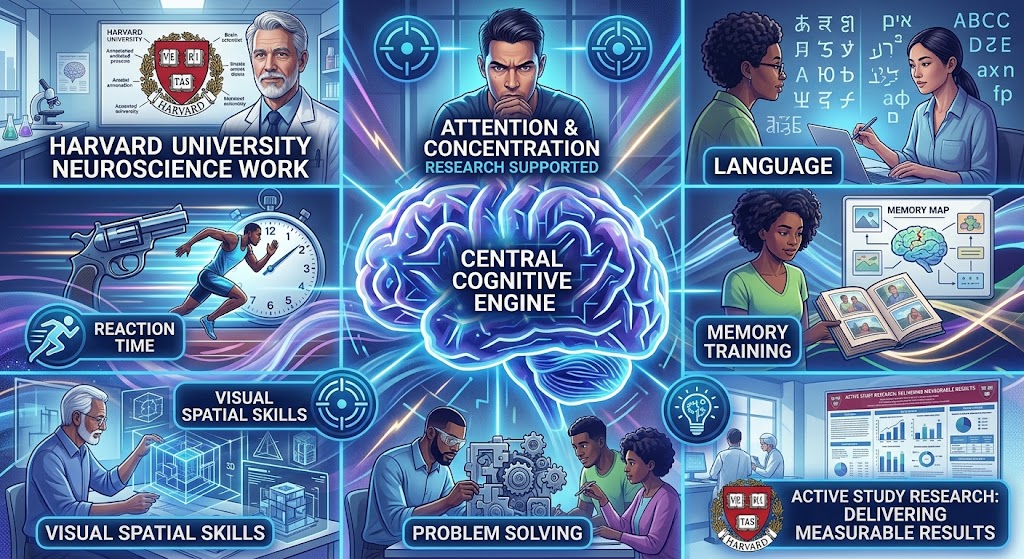
During my internship, I assisted in spearheading a dedicated Mind Aerobics program; it focused on keeping participants mentally sharp, resilient, and deeply engaged. I introduced a variety of targeted brain games every week; these exercises challenged six critical neural domains, forcing the mind to adapt and refine its pathways. The response was incredible; participants loved the interactive mental workouts, showing up consistently week after week to push their cognitive limits.
Research, Origins, and How Mind Aerobics Works Today
The Mind Aerobics suite was developed over more than a decade of neuropsychological research led by the New England Cognitive Center (NECC).Clinical trials evaluating structured cognitive interventions – such as the landmark ACTIVE trial (featuring researchers from Johns Hopkins University, Penn State, and Harvard Medical School) – demonstrated that target-driven mental training systematically slows cognitive decline.
- The Mechanism:Mind Aerobics operates by systematically challenging six core domains: reaction time, visual-spatial skills, attention/concentration, language, problem-solving, and memory.Tasks adapt dynamically, increasing in speed and complexity as participants build neural connections.
- Where It Is Used Today:It is widely implemented across community organizations, senior centers, and health networks (such as Jewish Family Service initiatives, adult day centers, and assisted living facilities).
- Clinical Effectiveness:Independent evaluations show that Mind Aerobics stabilizes cognitive function, preserves functional independence, and delivers measurable improvements in short-term memory, attention span, and processing speed.
Activities to Boost Cognitive Plasticity and Prevent Decline
- Dual N-Back Drills: Forces the brain to track simultaneous visual and auditory cues; this sharpens working memory and drives structural brain plasticity.
- Speed of Processing Tasks: High-speed computerized exercises challenge visual discrimination under tight time constraints; clinical research proves their efficacy on platforms like BrainHQ.
- Complex Skill Acquisition: Learning a new language or picking up an instrument builds cognitive reserve; it forces neural networks to establish entirely new pathways.
- Dual-Task Exercise Routines: Combining physical movement with cognitive tasks (e.g., cycling while solving word puzzles or counting backward) activates synaptogenesis.
- Tactile & Non-Dominant Motor Drills: Using your non-dominant hand for daily routines forces the brain’s motor cortex to form fresh synaptic connections.
- Strategic Spatial Navigation: Navigating new areas using physical maps rather than GPS strengthens the hippocampus and visual-spatial mapping skills.

Leave a Reply